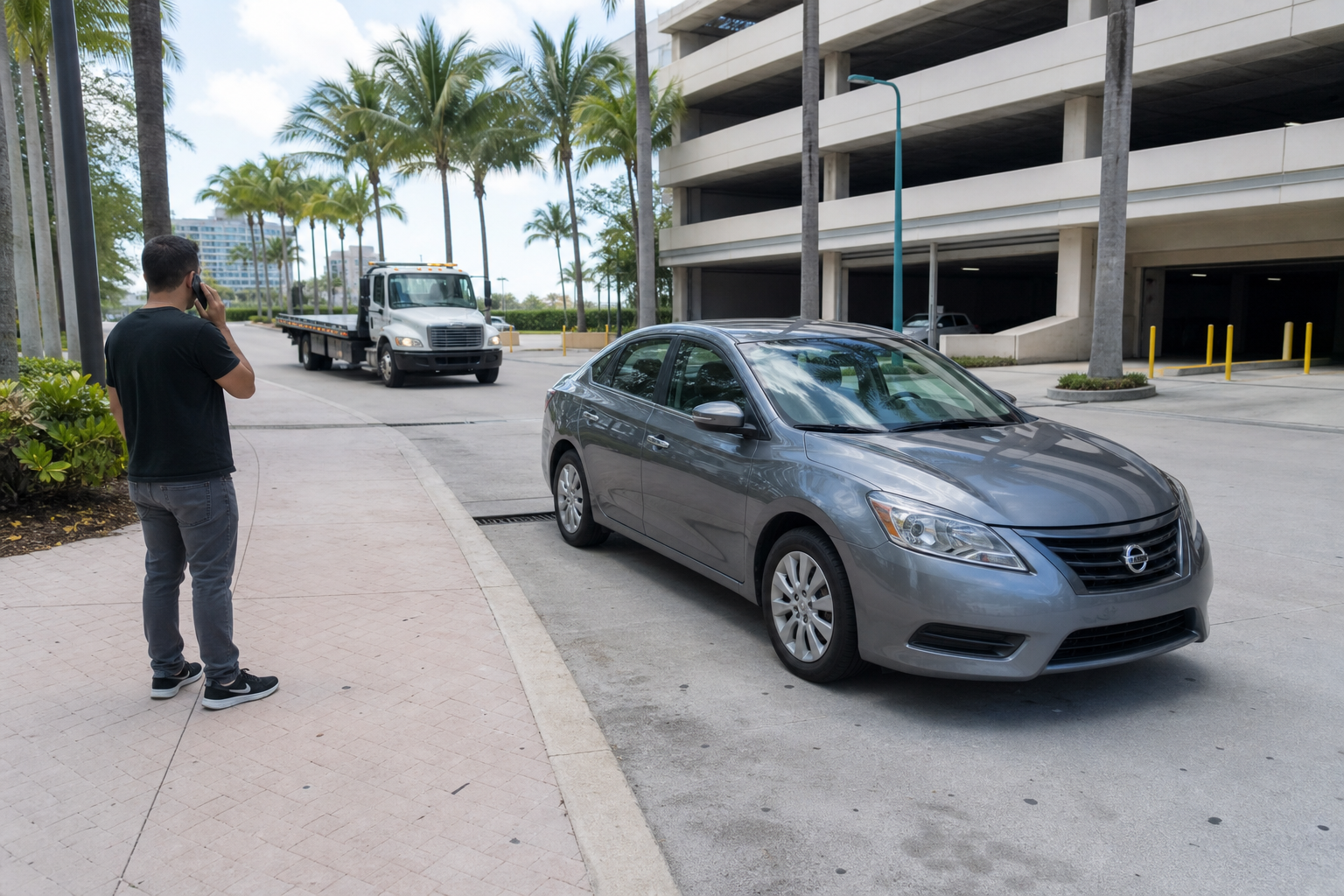
A steering or braking problem inside a West Palm Beach parking garage can become urgent faster than the same problem on an open road. Ramps, concrete columns, tight turns, and limited shoulder space leave little room to correct course. If your wheel suddenly becomes very hard to turn, your brake pedal sinks, or the vehicle will not slow normally, focus on reducing speed and getting out of the travel path—not on figuring out the cause.
Symptom or situation matrix: match the response to what the vehicle is doing
| What you notice | What to do first | What it means for the next move |
|---|---|---|
| Brake pedal feels soft, sinks, or needs much more distance to slow the vehicle | Lift off the accelerator, press the brake pedal firmly, and steer toward an open, level stopping area. If safe, use a lower gear to help reduce speed. | Do not resume driving after stopping. A pedal that does not respond normally needs a tow assessment. |
| Brake pedal is hard and braking assist seems reduced | Apply steady, firm pressure rather than repeated stomping. Give yourself much more room to slow down. | Stop as soon as a safe location is available. Do not test the vehicle by driving farther. |
| Steering wheel suddenly becomes heavy but still turns | Hold the wheel with both hands, reduce speed smoothly, and make only gradual steering inputs. | Power steering assistance may be gone. The vehicle may still steer, but it should be taken out of traffic and towed rather than driven onward. |
| Vehicle pulls sharply, wanders, shakes, or resists steering input | Keep a firm grip, avoid abrupt corrections, and ease off the accelerator. Aim for a straight, safe path to a stop. | Stop and request help. Continuing can make a tire, steering, or drivetrain-related problem harder to control. |
| Steering and braking response are both reduced | Use all available space to slow gradually. Warn other drivers with hazards and avoid sudden turns. | Treat this as an immediate stop situation. If you cannot safely stop or are in danger, contact emergency services first. |
Stop now or move only far enough to get out of the lane?
The right choice is not “keep going” versus “stop in the middle of danger.” It is usually one of these two options:
- Stop immediately if the vehicle will not slow predictably, the steering will not respond as expected, there is smoke or a burning smell, the vehicle is drifting toward people or objects, or you are already in a reasonably protected position.
- Move only to the nearest safer stopping point if you can still control speed and direction, but you are blocking an active lane, sitting at a garage ramp transition, or exposed in a traffic path. This means a short, deliberate move—not driving to a destination, shop, or home.
Do not turn the ignition off while rolling. Losing engine power can make steering and braking assistance more difficult, and some vehicles may lock the steering column depending on their system. Avoid using cruise control, avoid sharp lane changes, and do not attempt to “work out” the issue by repeatedly accelerating and braking.
If your vehicle has a parking brake, use it only with caution and gradually after you have already tried normal braking. A sudden application can destabilize the vehicle. Electronic parking brakes can operate differently by vehicle, so do not rely on one unless you know how yours responds.
Roadside checklist after you stop
- Secure the vehicle. Shift into park if possible, set the parking brake if it can be applied safely, and keep hazards on.
- Choose a safer waiting position. If leaving the vehicle is safer, exit on the side away from moving traffic. Do not stand downhill from the vehicle on a garage ramp or between the vehicle and a fixed object.
- Do not inspect underneath the vehicle. A fluid leak, damaged component, or hot area can create additional risk. A visual check from a safe distance is enough.
- Take a few useful notes. Record what changed first: heavy steering, brake warning light, pedal feel, pulling, vibration, fluid on the ground, unusual noise, or an engine stall. Those details help the towing provider plan the pickup.
- Check your exact location. In a parking garage, note the facility name, level, section, nearest entrance or exit, and any height-clearance signs. This matters because some tow equipment may need access from a specific level or entrance.
- Keep the key or key fob available. The tow operator may need it to unlock the steering, shift the vehicle, or position it safely. Do not leave it inside the vehicle.
If the issue appears limited to a minor roadside condition and the vehicle is fully controllable, roadside assistance may be the appropriate first call. If steering or braking response changed, err toward transport instead of a roadside restart or quick test drive.
When towing is the safer decision
Call for towing when the brake pedal remains soft or hard, the steering remains unusually heavy, the vehicle pulls or wanders, warning lights appear with a handling change, or you cannot confidently control the vehicle at low speed. These are not conditions to drive through West Palm Beach traffic while hoping the response improves.
A flatbed tow is often a practical option for a vehicle with uncertain steering, braking, or wheel movement because it minimizes the need to roll the vehicle during transport. The dispatch team can determine the appropriate equipment based on what the vehicle is doing and where it is stopped.
If you are in a traffic-exposed location, unable to move safely, or dealing with a complete loss of control, seek emergency help first. Once the immediate hazard is managed, arrange emergency towing for the vehicle.
Service preparation: what to tell the dispatcher
A clear first call can reduce delays and prevent the wrong equipment from arriving. Start with the control problem, then describe the access conditions.
- Your location in West Palm Beach, Palm Beach County, Florida, including the nearest identifiable entrance, cross street, or facility name.
- Whether the vehicle is on a flat surface, a ramp, a curbside area, or inside a parking structure.
- For a garage: level, section, clearance restriction, whether the vehicle can roll, and whether the wheels can turn.
- Whether braking is weak, absent, locked, or simply feels abnormal.
- Whether steering is heavy, locked, pulling, or partially responsive.
- Vehicle make, model, approximate position, and whether the keys are present.
- Any immediate obstruction, such as a blocked lane or a location where the vehicle cannot be approached from the front or rear.
Decision-based next step: If the vehicle does not brake and steer normally right now, do not drive it farther for diagnosis. Request 24-hour towing and give the dispatcher the symptom and access details above. If the vehicle is safely parked and the symptom has fully cleared, arrange an evaluation before putting it back into regular use.
Quick questions drivers ask
Can I drive if the steering wheel is heavy but still turns?
No regular driving is recommended. A vehicle can remain physically steerable after power assistance is lost, but low-speed turns, parking maneuvers, and emergency corrections may require far more force than expected. Stop safely and arrange transport.
Should I pump the brakes if the pedal goes down?
You may try firm, controlled pedal applications while reducing speed, but do not let repeated pumping distract you from steering to a safe stop. If braking response does not return immediately and reliably, do not continue driving.
What if the problem happens in a parking garage?
Prioritize stopping before the next ramp, turn, or gate if possible. Tell the towing dispatcher the garage level, clearance information, and whether the vehicle can roll or steer. Those details affect how the vehicle can be reached safely.
Can roadside assistance fix a loss of steering or braking response?
Roadside assistance can help evaluate some simple situations, but a change in steering or braking response often calls for towing rather than an on-site fix. Describe the exact symptom so the service can be routed appropriately.