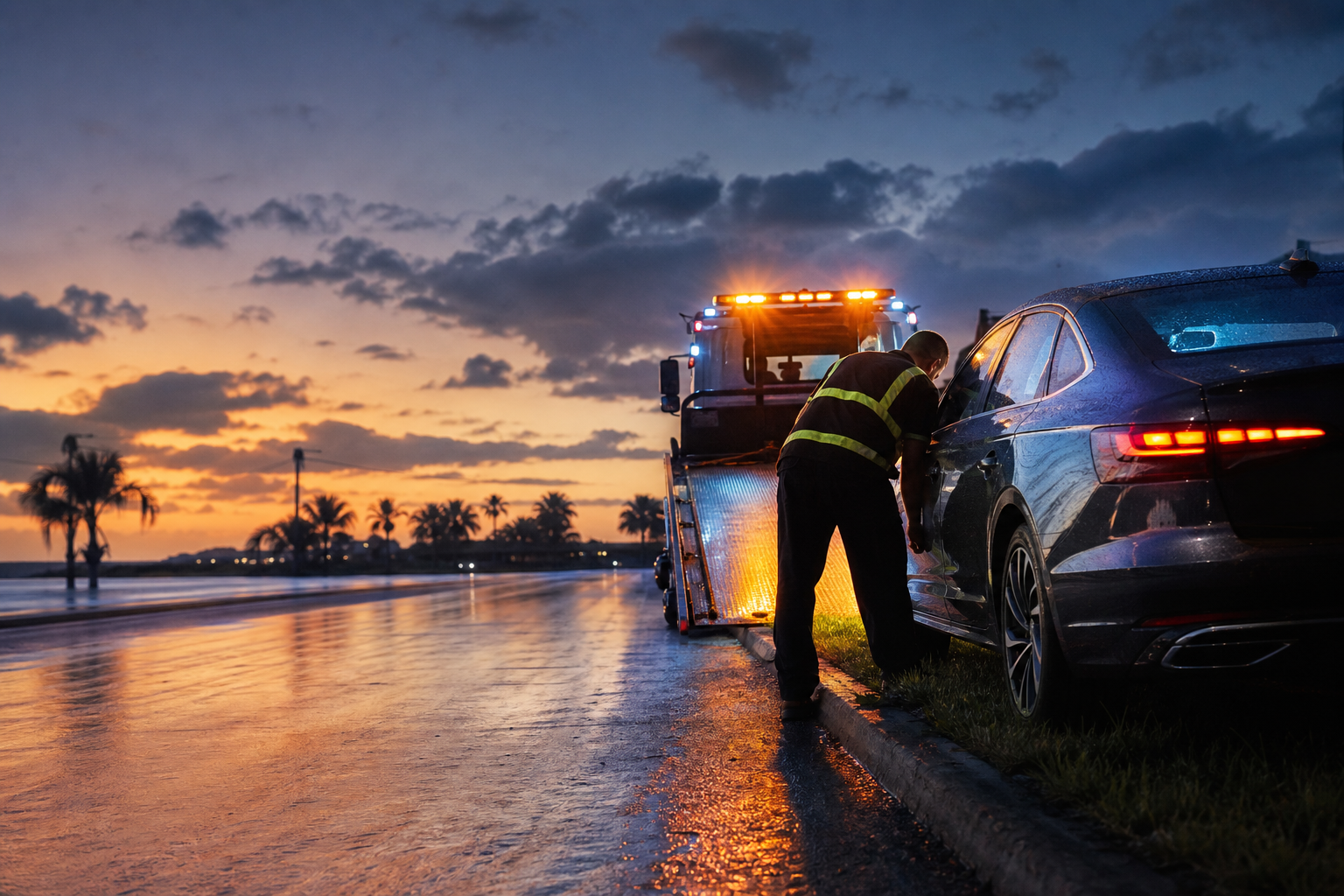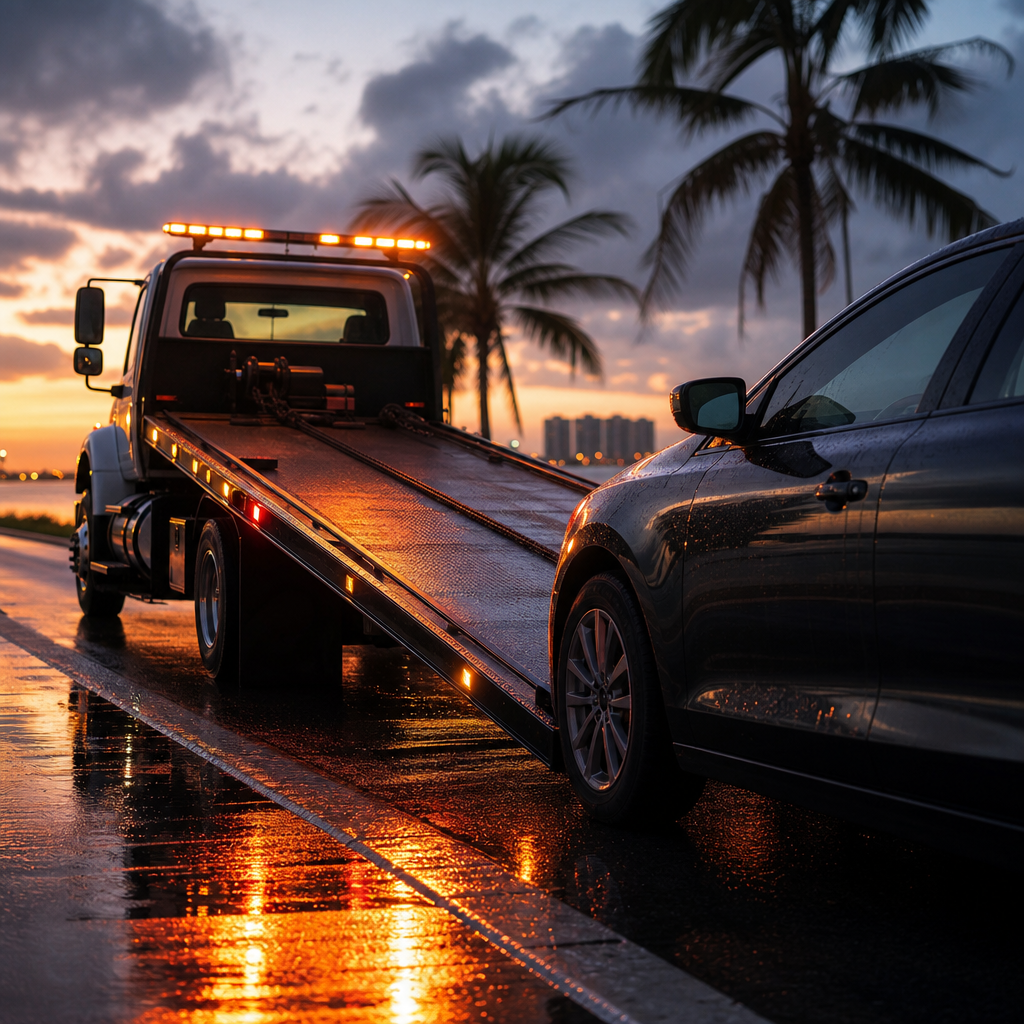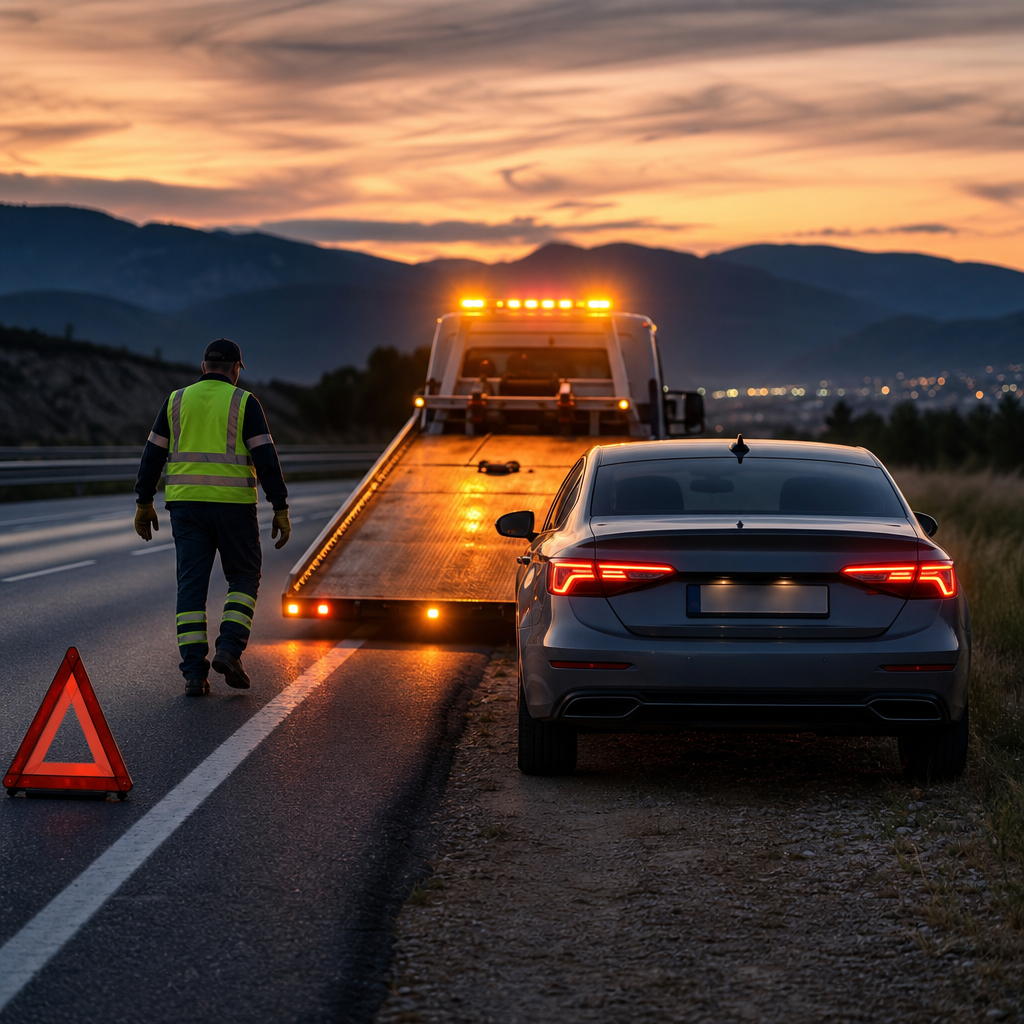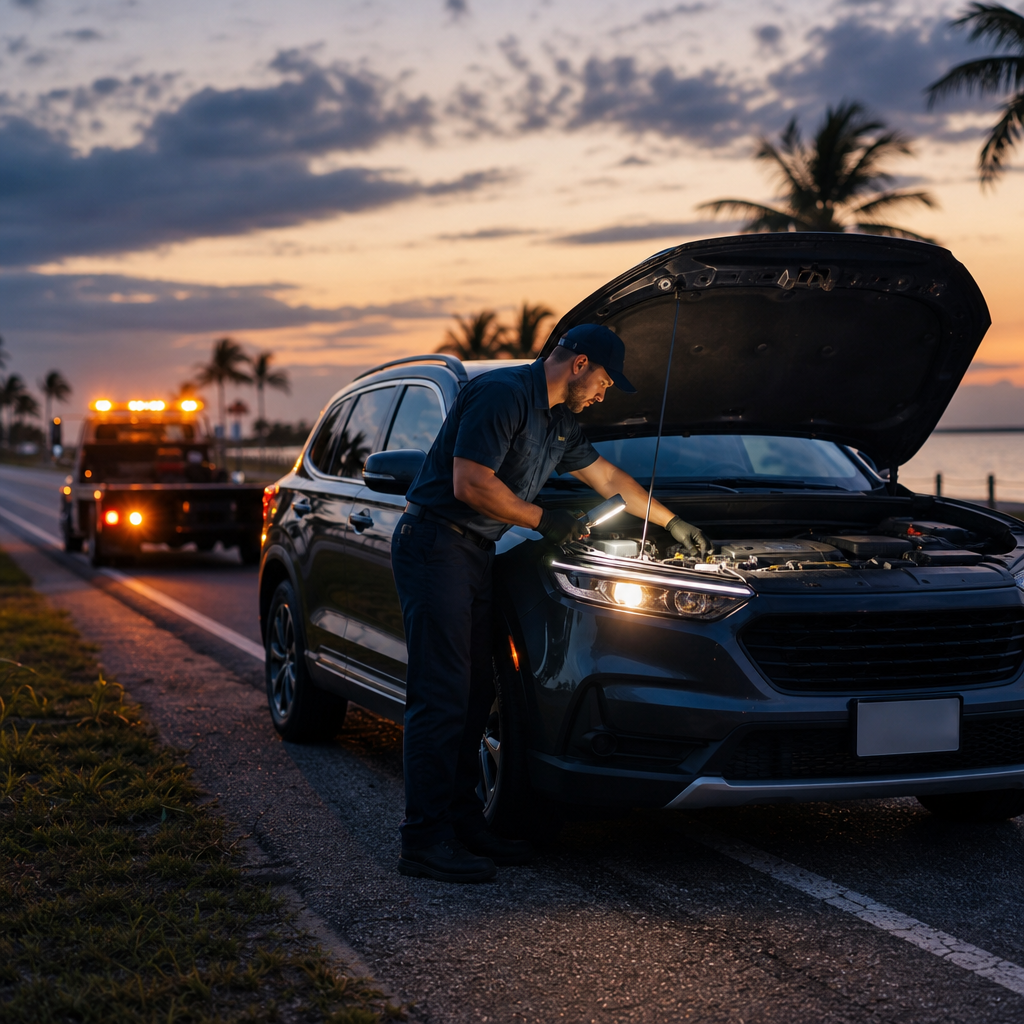
A vehicle problem can become a towing-method problem quickly in West Palm Beach, especially when the car is stopped in a tight parking-garage lane, a crowded airport-access area, or another place where there is little room to reposition it. The right question is not simply “Do I need a tow?” It is: Can this vehicle move safely, and if not, what method avoids making the problem worse?
Do this first: Move out of the travel path only if the vehicle can be moved without dragging, grinding, steering difficulty, overheating, or a warning of lost power. If it cannot, stop trying to reposition it. Turn on hazard flashers, choose a safe place away from traffic when possible, and note the vehicle’s exact position, access limits, and visible damage before requesting help.
This guide helps you decide among driving, roadside assistance, a wheel-lift tow, and a flatbed tow. If there is any uncertainty about drivetrain condition, wheel damage, or clearance, request a towing provider and explain what happened rather than attempting repeated starts or short “just get it home” drives. For immediate help, use 24-hour towing service or roadside assistance.
Before the problem: know the vehicle details that change the tow method
You do not need to become a towing expert before calling, but a few details help the dispatcher and tow operator select suitable equipment.
- Drive type: Front-wheel drive, rear-wheel drive, all-wheel drive, four-wheel drive, or electric vehicle. This is often the biggest factor in deciding whether a wheel-lift method is appropriate.
- Wheel and tire condition: A flat tire is different from a bent wheel, loose wheel, damaged suspension, or a tire that has come apart.
- How the problem began: A no-start, overheating warning, collision impact, curb strike, scraping noise, loss of steering feel, or transmission concern each points to different risks.
- Vehicle position: Tell the provider if the vehicle is inside a garage, near a low-clearance entrance, behind a gate, in a narrow lane, or in an airport-area pickup or access zone.
- Manufacturer instructions: If available, check the owner’s manual towing section. Some vehicles require all wheels off the ground or have specific transport instructions.
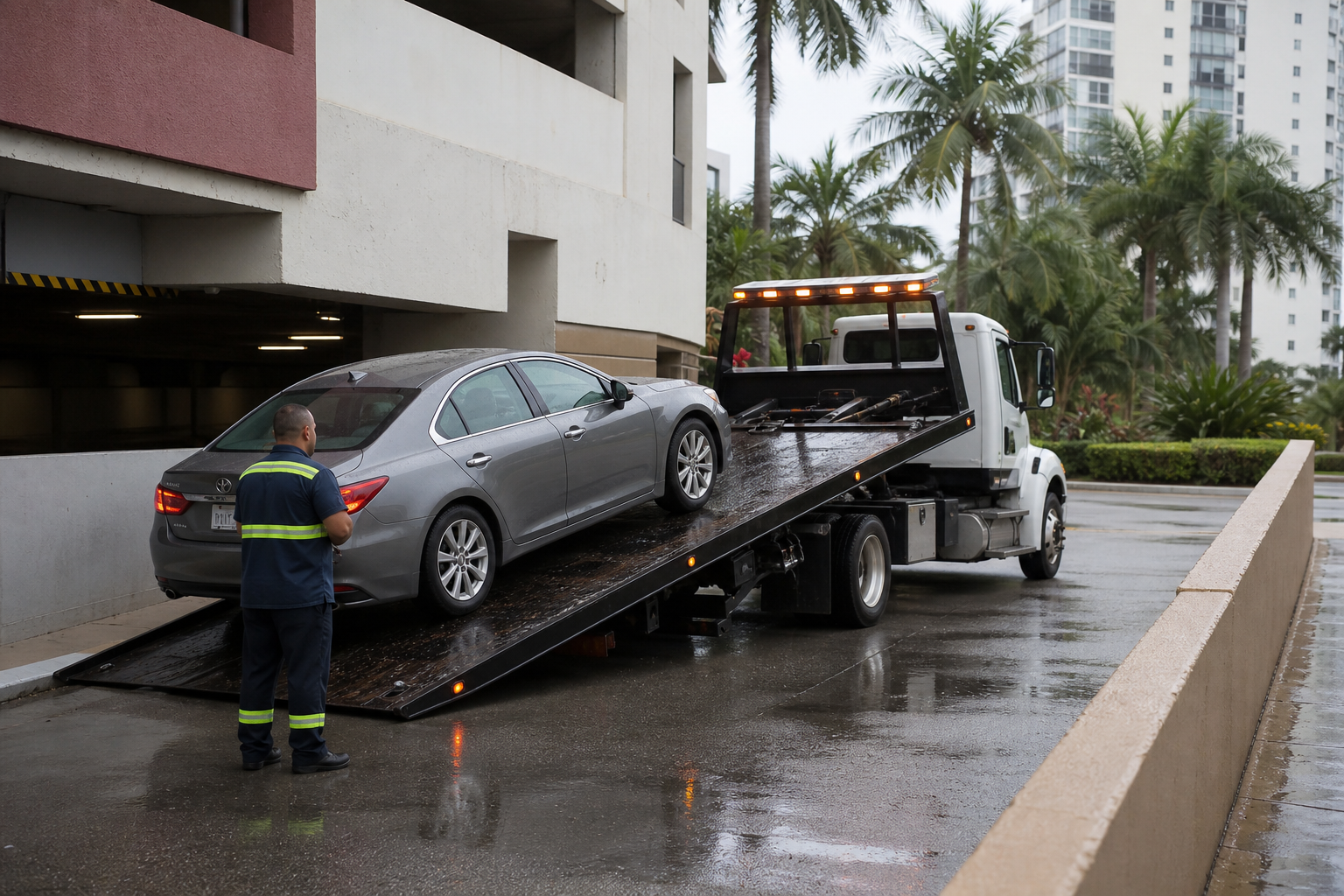
Flatbed towing carries the whole vehicle on a platform, keeping all four wheels off the road. Wheel-lift towing raises one end of the vehicle while the other end rolls on the road. A wheel-lift can be an effective option for compatible vehicles and access situations, but it is not automatically suitable for every drivetrain or damage condition.
At the roadside: use the tow-or-drive decision tree
Start at the top. Stop at the first answer that fits your situation.
-
Is there smoke, a burning smell, fluid actively leaking, loose parts, severe wheel damage, or a vehicle that will not steer normally?
Yes: Do not drive it. Request towing. A flatbed is generally the safer request when the wheel, suspension, underbody, or drivetrain may be affected.
No: Continue. -
Did the vehicle strike a curb, deep pothole, parking barrier, or another object?
Yes: Avoid assuming it is driveable because it still starts. If there is vibration, a pulled steering wheel, rubbing, tire damage, or a visible lean, request a flatbed. Hidden wheel or suspension damage can worsen while rolling.
No: Continue. -
Is this only a simple roadside issue, such as a dead battery, lockout, empty fuel situation, or a tire that can be safely addressed where it sits?
Yes: Request roadside assistance first. If the vehicle starts and operates normally afterward, a tow may not be needed. Use emergency towing if the roadside issue cannot be resolved or the vehicle remains unsafe to drive.
No: Continue. -
Does the vehicle have all-wheel drive, four-wheel drive, an electric drivetrain, or unclear towing instructions?
Yes or unsure: Request a flatbed and tell the provider the vehicle type. Keeping all wheels off the pavement avoids relying on assumptions about which wheels may roll during transport.
No: Continue. -
Is it a compatible front-wheel-drive or rear-wheel-drive vehicle with no apparent wheel, steering, transmission, or suspension damage?
Possibly: A wheel-lift tow may be appropriate if the tow operator confirms the vehicle can be transported that way. The operator should account for the driven wheels, vehicle condition, and manufacturer guidance.
Not sure: Ask for a flatbed. It is the more conservative choice when the condition cannot be confirmed from the roadside.
Quick method guide
| Situation | Best next request | Why |
|---|---|---|
| Vehicle will not start, but no impact or visible damage | Roadside assistance, then towing if needed | A battery, fuel, or basic no-start issue may be resolved without transport. |
| Damaged wheel, tire separation, scraping, or suspension concern | Flatbed towing | Rolling the affected end can create additional damage or instability. |
| All-wheel drive, four-wheel drive, EV, or unknown towing requirements | Flatbed towing | All wheels remain off the road while the vehicle is transported. |
| Compatible two-wheel-drive vehicle, no apparent damage, straightforward access | Wheel-lift may be suitable | The operator can confirm safe lifting and rolling configuration. |
| Low-clearance garage or constrained-access location | Describe the access before dispatch | Equipment selection and recovery approach may be affected by the available space. |
While waiting: protect the vehicle and give useful dispatch details
Once help is requested, your job is to make the location and vehicle condition clear. Do not crawl under the vehicle, try to push it through traffic, or repeatedly attempt to drive it if it is making abnormal noises or will not move correctly.
Information-ready call checklist
- Your location in West Palm Beach and the safest available description of where the vehicle is positioned.
- The vehicle year, make, model, color, and drive type if known.
- What occurred immediately before the problem: no-start, warning light, impact, flat tire, overheating, or loss of power.
- Any visible tire, wheel, fluid, bumper, or underbody damage.
- Whether the vehicle is in a garage, near a restricted entrance, or in another constrained-access area.
- Whether the wheels turn, the steering wheel moves normally, and the vehicle can be shifted safely.
- Your preferred destination, if you already have one.
If you are uncertain which tow method to request, say so directly: “The vehicle is [drive type if known], it has [symptom or damage], and it is located [access detail]. Can the operator assess whether flatbed towing is needed?” That gives the towing team the facts needed to plan the response.
After service arrives: confirm the plan before loading
Before the vehicle is moved, point out any damage or concerns you noticed. Tell the operator about drivetrain type, warning messages, unusual noises, and anything that may affect loading. If a garage, tight entrance, or limited turning area is involved, mention it again before equipment is positioned.
A professional tow operator will determine the final safe loading approach based on the vehicle, its condition, and the scene. If you expected a wheel-lift but the operator recommends a flatbed, ask what condition or vehicle feature drove that recommendation. If a flatbed is impractical because of access, ask what steps will be used to protect the drivetrain and damaged areas during recovery.
Remove personal essentials before the vehicle leaves if it is safe to do so: identification, keys not needed by the operator, medications, and important belongings. Then verify the destination and contact information. For planned transport after a roadside assessment, see flatbed towing service.
Common driver questions
Is a flatbed always better than a wheel-lift?
Not always. A wheel-lift can be suitable for certain compatible vehicles in good rolling condition. Flatbed towing is generally the more cautious option when the vehicle has drivetrain uncertainty, wheel or suspension damage, all-wheel drive, four-wheel drive, EV components, or unclear manufacturer instructions.
Can I drive a short distance with a damaged tire or wheel?
Do not drive if the tire is separated, the wheel is bent or loose, the vehicle pulls sharply, there is scraping, or steering feels abnormal. A short distance can turn a contained wheel or suspension problem into more extensive damage. Request roadside assistance or towing instead.
What should I request if my car will not start?
Request roadside assistance first if there is no collision damage, smoke, fluid leak, or other safety concern. If the vehicle cannot be started or safely driven after the roadside assessment, arrange towing.
Why does a parking garage matter for towing?
Garage height, turning space, lane width, and exit access can affect which equipment can reach the vehicle and how it can be loaded. Tell dispatch that the vehicle is in a garage and provide the most precise access details you can.
What if I do not know whether my vehicle is AWD or FWD?
Do not guess. Check the owner’s manual, vehicle badging, or tell the towing provider that the drivetrain is unknown. When towing requirements are uncertain, requesting a flatbed is a sensible starting point.